
Sandalwood Home Fragrance: The Complete Guide
What Is Sandalwood?
Sandalwood is one of the oldest and most valuable fragrance materials on earth. Derived from the heartwood of trees in the Santalum genus, it has been used for over four thousand years across India, the Middle East, Egypt and China in sacred ritual, medicine, and perfumery. The finest sandalwood, Santalum album, Mysore sandalwood from Karnataka in southern India, is now protected after decades of over-harvesting. The trees are slow-growing and hemiparasitic, drawing nutrients from the roots of neighbouring plants, and the heartwood is not ready for extraction until the tree is at least thirty years old. The best oil comes from trees aged fifty years and above. This is not a material that can be rushed. That patience is in the scent.
Today, genuine Mysore sandalwood oil is rare and government-regulated. Modern perfumery supplements it with Australian sandalwood (Santalum spicatum), plantation-grown varieties, and high-grade synthetic equivalents like Javanol, compounds that capture the creaminess of natural sandalwood with a consistent, sustainable profile. At LK Verdant, our sandalwood compositions use the highest-grade materials available.
What Does Sandalwood Smell Like?
The first word that comes up, and the most accurate: creamy. Sandalwood smells like warm skin. Smooth, milky, slightly woody, with a gentle sweetness that sits nowhere near sharp or sour. It is a base note, which means it reveals itself slowly and holds longest. Unlike oud, which announces itself, sandalwood settles. It fills a room quietly and stays for hours.
Beyond the creaminess, it is warm and slightly balsamic, with a soft woodiness that is the opposite of cedar's pencil-shaving dryness. It has therapeutic depth too, clinically associated with reduced anxiety and improved sleep onset, which is part of why it has been used in meditation and contemplative traditions across cultures for millennia. In perfumery, sandalwood is called a fixative: it extends and anchors every other note it sits alongside. This is what makes it appear in the base of nearly half of all luxury fragrances. It makes other materials better.
Mysore sandalwood has a particular milky richness that synthetic alternatives approach but rarely match. Australian sandalwood is lighter and woodier. Both are worthy. The difference is in the depth of the base.
Sandalwood as an Alcohol-Free Perfume Oil
One of the reasons sandalwood performs so well in home fragrance and alcohol-free perfume oil formats is its longevity and base-note character. Without the alcohol carrier stripping the top notes, sandalwood's full creaminess comes forward from the first breath. It does not need to dry down. In a reed diffuser oil or scented oil burner, the warmth of the material releases over hours rather than minutes, which is the format it genuinely suits best. If you are looking for an alcohol-free perfume oil for home use, sandalwood-based compositions are the natural starting point: long-lasting, skin-close, and warm without being heavy.
Where to Use Sandalwood
Sandalwood is the most versatile home fragrance note available. With rose and jasmine it becomes romantic. With oud and myrrh it becomes ceremonial and deep. With citrus it becomes grounded and clean. On its own it is calm, steady and entirely liveable.
In the bedroom, sandalwood is the first recommendation. Its neurological association with calm, its long history in sleep aromatherapy, and its ability to suggest warmth without demanding attention make it ideal for night-time use. A sandalwood reed diffuser running continuously at low concentration is one of the most effective sleep-support fragrance choices in the collection. The Wilderness Scented Oil is the format to reach for.
In the living room in autumn and winter, sandalwood delivers the warm, enveloping evening atmosphere that expensive candles try and often fail to produce on their own. Pair it with rose or amber for added depth, or let it stand alone for a quieter luxury.
In a home office, sandalwood's grounding quality aids focus without tipping into sedation. Less stimulating than citrus, less heavy than oud. It occupies a useful middle register for sustained concentration.
In the bathroom, a sandalwood scented oil combined with light florals or eucalyptus transforms the room. A small change with a disproportionate effect.
This versatility is precisely why sandalwood anchors the best luxury hotel room fragrances. Warmth and depth without specificity. It is the safest note for a guest bedroom precisely because almost everyone responds well to it.
Getting the Most from Sandalwood
Because sandalwood is a base note, it reveals itself gradually. Reed diffusers and scented oils suit it best, as the continuous slow release allows the warmth to build properly. Sandalwood's creaminess emerges over time rather than arriving all at once. Wax melts deliver it well too, particularly over longer sessions.
For an immediate hit, a room spray works. The main thing to avoid is over-layering. Sandalwood functions as both a feature note and a base, so decide which role it is playing before you start building a composition.
The LK Verdant Sandalwood Blends
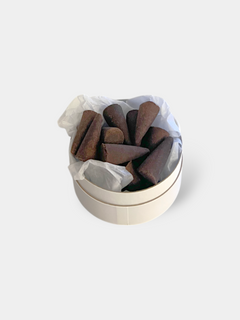
Sandalwood appears in our Arabian Tonka Oud Incense Cones as the velvety base alongside lily, oud and amber. In the Wilderness range, it underpins the floral oriental character throughout. In the Vanilla Oud Incense Cones, it adds smooth depth alongside myrrh, tonka and Bulgarian rose.
Shop incense cones | Shop scented oils | Browse the full collection
Sandalwood: Frequently Asked Questions
What does sandalwood smell like?
Sandalwood smells creamy, warm and woody. Like warm skin with a gentle, slightly sweet woodiness. It is smooth and soft rather than sharp, and it reads as luxurious without being demanding. One of the easiest fragrance notes to live with.
Is sandalwood a masculine or feminine scent?
Neither. Sandalwood has been used across cultures, genders, and centuries without any strong association. It is genuinely neutral and suits any room, any person, and almost any other fragrance note.
What does sandalwood pair well with?
Sandalwood pairs with almost everything. With rose or jasmine, it becomes warm and romantic. With oud or myrrh, it becomes deep and ceremonial. With vanilla, it softens into something almost gourmand. With citrus, it grounds the freshness into something longer-lasting. It is the note that makes other notes hold.
Is sandalwood similar to oud?
They are related but distinct. Both are warm, woody and long-lasting, and they pair beautifully together. But sandalwood is softer, creamier and more approachable than oud. Oud is resinous, sometimes smoky, occasionally animalic. Sandalwood is quiet depth. Read our oud guide for the full comparison.
What is the best format for a sandalwood home fragrance?
Reed diffusers and scented oils, because sandalwood needs time to reveal its full character. The continuous low-heat release of a reed diffuser is the format that suits it best. Incense cones deliver the most ceremonial expression. Room spray gives you instant warmth when you need it.
Related guides: Bedroom guide | Living room guide | Oud & agarwood guide | Sleep & Bedtime edit | Calming edit | Meditation & Ritual edit