
Oud & Agarwood: The Complete Home Fragrance Guide
What Is Oud?
Oud is one of the oldest and most expensive raw materials in perfumery. Also known as agarwood, it is the dark, resinous heartwood that forms inside Aquilaria trees when they become infected with a specific mould. The tree responds by producing a rich protective resin, and over decades, sometimes centuries, that resin saturates the wood. The result is oud. It forms naturally in fewer than two percent of wild Aquilaria trees, which is why genuine oud in fragrance commands the prices it does. It has been burned in Arabian households for centuries, carried in Japanese kodo ceremonies, and worn by royalty across the Middle East and South Asia. Its presence in modern luxury perfumery is not a trend. It is a homecoming.
The Aquilaria tree grows across Southeast Asia: Malaysia, Indonesia, Thailand, Cambodia, Vietnam, as well as parts of the Indian subcontinent and the Arabian Peninsula. The species, the region, the age of the wood, and the method of extraction all affect the final character of the oil. This is part of what makes oud in perfume so difficult to pin down, and so endlessly compelling.
What Does Oud Smell Like?
If you are asking what an oud scent is, the honest answer is: it depends on the concentration and what it is paired with. Oud is not a single, fixed smell. It is a register.
At its most elemental, oud is woody and smoky, with an earthy undertone that sits somewhere between damp forest floor and dry aged wood. There is warmth in the base, a sweet, balsamic depth, and an animalic quality at higher concentrations that most people find either compelling or confronting. Softened with rose, it becomes romantic and enveloping. Paired with amber or sandalwood, it reads as deeply grounding. Lifted with musk, it softens into something almost meditative.
What oud perfume is not: thin, sharp, or forgettable. Oud in fragrance fills a room. It lingers. It evolves on the skin and in the air across hours. If you want to understand what oud smells like in three words: warm, deep, complex.
The character also shifts between formats. Oud burned as incense carries more smoke and ceremony. Oud in a scented oil or reed diffuser delivers a lower, sustained presence: the same warmth, less theatre. Both are valid. They serve different rooms, different moments, different moods.
Is Oud Rare?
Yes, genuinely. Agarwood forms only under specific conditions of infection and stress, in a species of tree that is now protected across much of its natural range due to over-harvesting. The volume of natural oud oil produced globally is tiny relative to demand. This is why oud in perfume and home fragrance commands its price. Not as a marketing position, but as a material fact.
The best oud is aged. Time deepens the resin and smooths out harsher edges, producing an oil of extraordinary complexity. What you experience in a well-made oud perfume or home fragrance is the result of decades of formation and years of careful refinement. Not a synthetic shortcut.
Oud In Your Home
Oud has anchored Arabian and Sufi practice for centuries for good reason. Burned during prayer, ceremony and contemplation, it has a ceremonial gravity that few other materials match. In a home fragrance context, that gravity translates into presence. Oud fills a room in a way that feels considered rather than decorative.
In the hallway, oud makes an immediate and lasting first impression. It tells your guests something about your taste before they have crossed the threshold: that luxury hotel lobby effect before anyone has even taken off a coat.
In the living room, oud creates atmosphere rather than just scent. The resinous base lingers without becoming clinical. Pair it with amber or sandalwood for grounded warmth, or let it stand alone if your space can carry it.
In the bedroom, a softer oud that leans into rose or light musk settles well. Rich enough to feel genuinely luxurious, without disturbing sleep. Velvet rose and oud is one of the most requested combinations in home scenting for good reason: romantic, grounding, and deeply comforting.
In a meditation or prayer space, oud incense grounds the practice in a sensory register that has been used across contemplative traditions for millennia. The smoke, the warmth, the slow unfurling of the note. It is not accidental that oud has been central to ritual across cultures. It focuses the mind.
Start with less than you think you need. Whether you are using a diffuser, room spray, or incense cone, oud's sillage is impressive. A single cone or a few sprays will do considerably more than a floral or citrus note of equivalent volume. Let it build.
Velvet Rose and Oud
The pairing of velvet rose with oud is one of the most requested combinations in luxury home scenting. Rose softens oud's edges without stripping its depth, adding a floral brightness that lifts the resin into something more accessible: romantic without being sweet, complex without being difficult. The two notes have been combined in Middle Eastern, Indian and European perfumery traditions for centuries, independently arriving at the same conclusion: they belong together.
Explore our velvet rose and oud collection to find the right intensity for your space.
Which Format to Choose
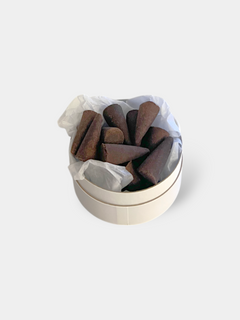
Incense cones are the most authentic format for oud. The act of burning resin goes back thousands of years, and oud in cone form delivers the note at its most complex and ceremonial. Our hand-pressed incense cones contain oud and agarwood without charcoal accelerants, which means the smoke is clean and the fragrance composition comes through undistorted.
Scented oil in a burner or reed diffuser delivers oud at lower, continuous concentration. Better suited for everyday use, and for spaces where you want the note to build over hours rather than make an immediate statement.
Room spray gives you instant transformation, useful when you want to shift the atmosphere of a room quickly.
None of these is more correct than the others. They are different tools for different moments and different rooms.
Oud by Mood
Oud anchors the romantic, the meditative and the calming edits. It is not an energising note. It is not a morning note. It is the note you reach for when the day is winding down, when the room needs to feel like somewhere worth being. It suits candlelight and low lamplight. It suits slow evenings and long weekends. For morning energy, reach for something from the Botanics range.
The LK Verdant Oud Collection
Our oud compositions draw on the Arabian perfumery tradition, where this note has always lived at its most expressive.
The Wilderness Incense Cones layer oud and agarwood with wild rose and peony for a softer, more floral register. The Vanilla Oud Incense Cones pair oud with myrrh, tonka, Bulgarian rose, vanilla and musk for a warm, sweet oriental. The Arabian Tonka Oud Cones carry the deeper, more assertive expression of the note alongside sandalwood, lily and amber. This is oud as it is meant to be experienced. All three are hand-pressed from natural resin without charcoal accelerants.
The Wilderness Scented Oil carries soft oud and agarwood alongside wild rose and peony for everyday diffusion at a lower, more sustained concentration.
Shop incense cones | Shop scented oils | Browse the full collection
Oud: Frequently Asked Questions
What is an oud scent?
An oud scent is any fragrance that features agarwood as a primary or significant note. Oud is woody, resinous and warm, with earthy, leathery and sometimes animalic depth depending on its concentration and what it is blended with. As a base note, oud in fragrance gives compositions their staying power and character.
What does oud smell like in a home?
In a home setting, oud smells warm, woody and slightly smoky. It fills a room rather than sitting quietly in the background. At lower concentrations, in a scented oil or diffuser blend, it reads as rich and enveloping without heaviness. At higher concentrations, as in incense, it has more ceremony and depth.
Is oud masculine or feminine?
Neither. Oud in perfume and home fragrance has been used across cultures without any strong gender association. It is genuinely neutral. The oud in your hallway diffuser does not belong to any category. It belongs to the room.
How long does oud fragrance last?
Oud is a base note, which means it has excellent longevity. In incense form, the scent can linger in a room for several hours after burning. In a reed diffuser or scented oil, it delivers sustained presence over days and weeks. Even a single room spray application of an oud blend will outperform most fresh or floral notes for lasting power.
Is sandalwood similar to oud?
Both are woody and warm, and they pair extremely well together, which is why oud and sandalwood appear frequently in Arabian and Indian perfumery. But they are distinct. Sandalwood is softer, creamier and more approachable. Oud is darker, more resinous, and considerably more complex. Think of sandalwood as the room and oud as the soul of it.
Related guides: Hallway fragrance guide | Bedroom fragrance guide | Meditation & ritual edit | Romantic edit | Calming edit | Wilderness collection